
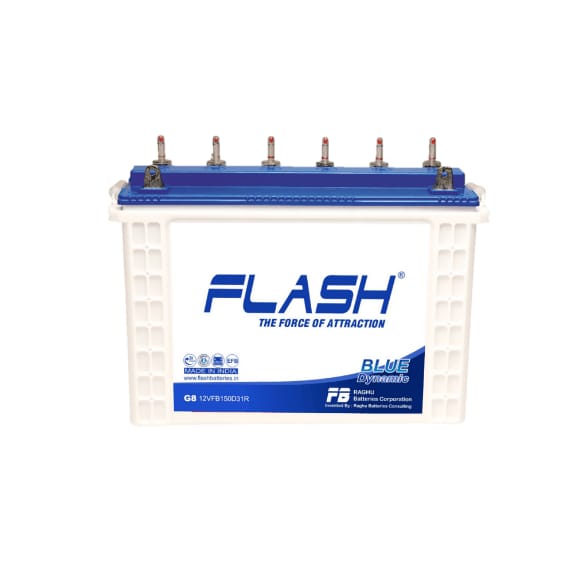
How to Select the Right Inverter Battery for Indian Homes (150Ah vs 240Ah Sizing Guide)
Learn the exact mathematical formulas to calculate your home power backup requirements and choose between 150Ah and 240Ah tall tubular batteries.
Raghu Batteries Consulting Engineering Desk
Flash Batteries
How to Select the Right Inverter Battery for Indian Homes
Frequent power cuts and soaring summer temperatures require a dependable inverter battery backup system. However, choosing the wrong capacity often leads to premature battery failure and insufficient runtime.
1. Calculating Your Household Wattage Demand
Before purchasing a battery, calculate the total electrical load of appliances you intend to run simultaneously during a power outage:
2. Converting Watts to Battery Ampere-Hours (Ah)
Battery capacity is measured in Ampere-Hours (Ah). To determine the required Ah for a desired backup duration:
`
Required Energy (Watt-Hours) = Total Load (Watts) × Desired Backup Time (Hours)
Example: 400 Watts × 4 Hours = 1,600 Watt-Hours
`
Assuming a standard single-battery inverter operating at 12 Volts DC with an industry inverter conversion efficiency of 80% (0.8):
`
Required Battery Ah = Energy (Wh) ÷ (Voltage × Efficiency)
Required Battery Ah = 1,600 ÷ (12 × 0.8) = 166.6 Ah
`
In this scenario, a 150Ah tall tubular battery delivers comfortable runtime for moderate loads, whereas a 240Ah battery is required if backup duration extends beyond 5 to 7 hours.
3. Flat Plate vs. Tall Tubular: Why Geometry Matters
4. Key Takeaways
1. Always oversize your battery capacity by 15-20% to prevent continuous 100% deep discharge. 2. Ensure your inverter charging current does not exceed 10-15% of the battery Ah capacity (e.g., 15 Amperes charging current for a 150Ah battery). 3. Use demineralized or distilled water for periodic top-ups to maintain electrolyte specific gravity at 1.250 ± 0.005 at 27°C.